·  Gautham · YouTube Strategy · 14 min read
YouTube and the B2B Buyer Journey: 82% Choose Day 1 Vendors
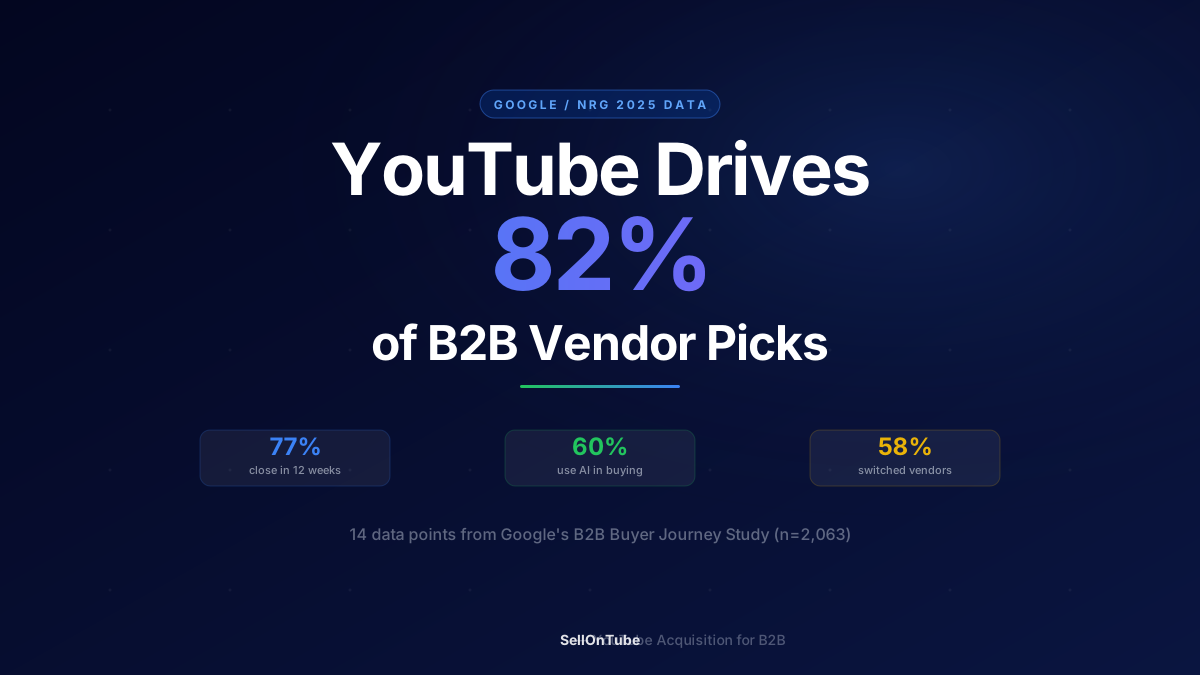
Google surveyed 2,063 B2B buyers. 82% chose vendors already on their shortlist. 60% used YouTube during evaluation. 14 data points that prove: if you are not on YouTube, you are not on the list.
You probably assume your B2B pipeline starts when a buyer types something into Google. Google’s own data says otherwise.
In a 2025 study of 2,063 senior B2B decision-makers, Google and National Research Group found that 82% of buyers already have a shortlist of vendors before they start researching. If you are not on that list, you are not in the running. The deal is decided before anyone opens a comparison spreadsheet. YouTube is one of the most effective ways to get on that shortlist.
Below are 14 data points from Google’s October 2025 “B2B Buyer Journey” report, and what each one means for your video strategy.
How Does YouTube Influence B2B Purchasing Decisions?
YouTube shows up at every stage of the B2B buyer journey, from first research to post-purchase support.
Google’s 2025 study of 2,063 B2B decision-makers found that 60% of buyers who used YouTube during research watched product tutorials before making a decision. During discovery, your buyers watch short explainer videos. During consideration, they watch deep product demos and walkthroughs. At the purchase stage, they look for onboarding previews and customer testimonials. After purchasing, 44% return to YouTube to find new use cases for the product they bought.
That post-purchase number matters most for you. 88% of buyers who used YouTube after purchasing said they were likely to recommend the product. Your YouTube content does not stop generating value when the deal closes. It creates your next referral.
Key Takeaways
- 82% of B2B buyers purchased from their “Day 1 List” of vendors they already knew
- 77% of buying journeys complete in 12 weeks or less; AI compresses this further
- 60% of B2B buyers use AI tools during their purchasing process
- 60% of YouTube-using buyers watched tutorials on the product they were evaluating
- 58% of B2B buyers switched vendors in the past six months
- 88% of buyers who use Google/YouTube post-purchase become likely to recommend
Contents
- 82% Buy From Vendors They Already Know
- Where B2B Buyers Research: The Platform Breakdown
- YouTube at Every Stage of the Buyer Journey
- 77% of Deals Close in 12 Weeks
- 58% Switched Vendors: Your Opportunity and Your Risk
- Five Rules B2B Buyers Expect (And What They Look Like on YouTube)
- What This Looks Like in Practice
- What to Do This Week
- FAQ
82% Buy From Vendors They Already Know
Day 1 List: the shortlist of vendors a B2B buyer already has in mind before starting any formal evaluation process.
Google’s research asked 1,305 buyers who had a Day 1 List whether they ended up buying from it. 82% said yes.
Read that again. Four out of five B2B deals go to vendors the buyer already recognized before researching. If you are competing on features during the evaluation stage, you are already too late. The deal was decided before anyone opened a comparison spreadsheet.
How do buyers build that mental shortlist? Through content they consume during their working lives. YouTube tutorials. LinkedIn posts. Podcast appearances. Conference talks. These create familiarity, and familiarity creates trust.
Here is the uncomfortable part.
If your company does not have a YouTube presence, you are invisible during the most important phase of the buying process. The phase that happens before anyone knows they are buying. (We break down the full framework in our YouTube marketing for B2B guide.)
Where B2B Buyers Research: The Platform Breakdown
The report maps which platforms B2B buyers use during research. Three channels dominate:
| Platform | Usage During Research | Role in Buyer Journey | Sample |
|---|---|---|---|
| Google Search | 94% | Discovery, validation, pricing, reviews | n=165 |
| AI Tools (ChatGPT, Gemini) | 60% | Vendor list generation, summaries, competitor surfacing | n=2,063 |
| Social (incl. YouTube) | 59% | Tutorials, demos, peer reviews, thought leadership | n=2,063 |
| Vendor Websites | 45% | Product specs, pricing, case studies | n=1,861 |
| Analyst Reports | 43% | Third-party validation, category analysis | n=1,861 |
Source: Google/NRG B2B Buyer Journey Study, Q2 2025. Vendor websites and analyst reports measured among AI tool users seeking validation.
Two things stand out.
First, 60% of buyers now use AI tools like ChatGPT and Gemini during their purchase process. They generate vendor lists, summarize product capabilities, and surface competitors. But AI is not the final word. 63% of those AI users then turn to Google Search to validate what the AI told them. AI starts the conversation. Google and YouTube finish it.
Second, social platforms (which include YouTube) are used by 59% of buyers during research. B2B tech buyers are even more likely to use social touchpoints than average. YouTube is not a consumer entertainment platform your B2B company can ignore. It is a research tool your buyers already use.
YouTube at Every Stage of the Buyer Journey
The report maps YouTube’s role across all four stages. This is not a platform that matters only during discovery. Buyers return to it repeatedly.
Discovery
Buyers start with short explainer videos and early thought leadership content. At this stage, they are not comparing vendors. They are framing the problem. A three-minute video that names the problem clearly gets remembered when the buying process kicks off weeks later.
Consideration
This is where YouTube earns its weight. Among buyers who used YouTube during research, 60% watched a tutorial on the product or service. That is not passive viewing. That is active evaluation. They watched someone use the product and decided whether it solved their problem.
The report also notes that 63% of those same buyers visited the brand’s website alongside YouTube. Video and website work together. YouTube builds conviction. The website closes the loop.
Purchase
During the purchase decision, buyers use YouTube for onboarding previews and customer testimonials. They want to see what happens after they sign. Will the product be easy to adopt? Will their team actually use it?
Post-Purchase
This is the sleeper stat in the report.
44% of all surveyed buyers used YouTube post-purchase to uncover new use cases or get more value from what they bought. Combined with Google Search, 83% of buyers stayed engaged with Google and YouTube after purchasing.
Why does post-purchase YouTube content matter so much?
Because 88% of buyers who used Google tools (Search, YouTube, Gemini) post-purchase said they were likely to recommend the product. YouTube does not stop working after the deal closes. It turns customers into advocates. (See how to measure this in our YouTube marketing ROI breakdown.)
Want us to map this journey for your business? We will show you where your buyers research, which stages you are missing, and what to publish first. Book a free 30-minute audit.
77% of Deals Close in 12 Weeks
The old B2B playbook assumed long sales cycles. Six months of nurturing. Quarterly business reviews. A slow build toward a decision.
That playbook is dead.
77% of surveyed buyers said their buying journey took 12 weeks or less. AI is compressing timelines even further. 84% of buyers said AI tools speed up their process.
Think about what this means for YouTube content.
You have, at best, 12 weeks from first awareness to signed deal. If your first video takes eight weeks to produce, you have already lost a quarter of that window.
This is why consistency matters more than production quality. The report explicitly says buyers prefer “short, clear, and useful content that solves problems.” Not polished brand films. Not agency-produced case studies with cinematic b-roll.
A founder recording a 5-minute walkthrough on their laptop outperforms a $20,000 brand video that takes three months to approve. (We cover the full conversion path in our YouTube lead generation guide.)
The cost of waiting: Every month without YouTube content is a month where buyers are forming Day 1 Lists that do not include you. With 82% buying from that list and 77% closing within 12 weeks, a six-month “YouTube strategy development phase” means missing two full buying cycles.
58% Switched Vendors: Your Opportunity and Your Risk
Here is where the data gets interesting for companies currently behind.
58% of buyers who purchased a B2B product in the past six months also switched vendors during that period. Vendor loyalty is weaker than most companies assume. Buyers are empowered, informed, and willing to move.
This cuts both ways.
If you are the incumbent, your existing customers are evaluating alternatives right now. Without ongoing YouTube content (tutorials, feature updates, use cases), you are giving them a reason to look elsewhere.
If you are the challenger, 58% of your competitor’s customers are open to switching. YouTube tutorials that show your product solving a specific problem can plant the seed.
The report reinforces this with a quote from a Senior Director at a financial services firm. When an executive asked “Can our product do this?” about a tool they had already purchased, the buyer went to YouTube, found tutorial videos, and confirmed the capability. That is retention driven by content, not by contract lock-in.
Are you creating content that helps your existing customers discover what your product can do? Or are you only making videos for prospects?
Five Rules B2B Buyers Expect (And What They Look Like on YouTube)
The report identifies five “rules of engagement” that determine whether a vendor stays on the Day 1 List. Each one maps directly to a type of YouTube content.
| Rule | What Buyers Want | YouTube Content That Delivers | Example Format |
|---|---|---|---|
| Clarity | Straightforward, clearly sourced information | Screen recording walkthroughs | ”Here is exactly how [feature] works in 3 minutes” |
| Proof | ROI metrics, benchmarks, real case studies | Customer interview videos, results breakdowns | ”How [Customer] reduced churn by 30%“ |
| Relevance | Content tailored to role, industry, pain point | Industry-specific playlists, use case videos | ”[Product] for healthcare teams” playlist |
| Simplicity | Short, useful, problem-solving content | Under-2-minute tutorials, quick how-tos | ”Fix [common problem] in 90 seconds” |
| Peer Validation | Credible voices sharing authentic stories | Founder vlogs, customer testimonials, community content | Unscripted customer interview on Zoom |
Five rules of engagement from Google/NRG B2B Buyer Journey Study, October 2025.
Workfluencer: a professional creator who shares workplace insights, product reviews, and industry knowledge. NRG’s research shows B2B buyers trust these voices the same way they trust a friend or colleague’s recommendation.
The report notes that buyers connect most with creators who share both wins and missteps openly. Overproduced content that feels like a polished ad actually works against you. Buyers want clarity and functionality over production quality. Google’s own words: “Overproduced assets can feel like marketing spin.”
Good news for B2B companies without a big video budget. Authenticity beats production value every time.
What This Looks Like in Practice
Company A: A SaaS compliance platform for financial services.
They build their YouTube channel around three content types:
- Weekly 3-minute feature walkthroughs (Clarity + Simplicity)
- Monthly customer interviews on Zoom (Proof + Peer Validation)
- Quarterly “Compliance in [Industry]” thought leadership (Relevance)
Within six months, their videos appear in YouTube results for problems their buyers search. When a compliance officer at a mid-market bank starts evaluating vendors, this SaaS company is already on the Day 1 List. Not because of a sales email. Because of a tutorial watched three months earlier.
Company B: A B2B consulting firm specializing in supply chain optimization.
They publish one YouTube video per week. The founder records a 5-minute screen share explaining a concept. No script. No editing beyond trimming the intro. Total production cost: zero dollars.
A procurement director at a manufacturing company watches three of these videos while researching supply chain improvements. When the RFP goes out, the consulting firm is already on the shortlist. The sales call feels like a continuation of the YouTube content, not a cold introduction.
From our work with B2B clients: Companies that start publishing consistent YouTube content see measurable pipeline impact within 90 days. Not because their videos go viral, but because they start appearing in the searches their buyers are already running.
Both companies followed the same principle: be useful before the buyer knows they are buying. That is how you earn a spot on the Day 1 List, and a 3-layer content strategy built around this exact journey shows how to structure it.
Estimate your return: Use our YouTube ROI Calculator to model the pipeline impact of a consistent YouTube strategy.
Decision guide: Should you start with YouTube or invest more in your existing channels?
✓ Start with YouTube if: your product requires explanation, your sales cycle involves multiple stakeholders, or your buyers research online before talking to sales.
✗ Delay YouTube if: you have not defined your ICP, your product is a pure commodity with no differentiation, or you cannot commit to one video per week for 90 days.
What to Do This Week
Five actions based on Google’s 2025 buyer data:
- Audit your Day 1 List visibility. Search YouTube for the problems your buyers face. Do your videos appear? If not, that is your starting point.
- Record one tutorial this week. Screen share a feature walkthrough or explain a common problem your buyers face. Keep it under 5 minutes. Post it. Do not wait for a “video strategy.”
- Create a post-purchase playlist. 44% of buyers use YouTube after purchasing. Help them succeed with your product, and they become your best salespeople (88% recommend rate).
- Check your AI visibility. 60% of buyers use ChatGPT or Gemini to build vendor lists. Search for your category in those tools. If you are not mentioned, YouTube content (which AI tools index) is one way to fix that.
- Stop overproducing. Google’s report says buyers want “short, clear, and useful content.” A founder talking to a camera beats a scripted brand video. Start this week, not next quarter.
Google’s data is clear: your buyers are already on YouTube. The question is whether they find you or your competitor. Book a 30-minute strategy call and we will audit your Day 1 List visibility, map your buyer journey gaps, and build a content plan backed by the data in this report.
FAQ
Does YouTube work for B2B lead generation?
Yes. Google’s 2025 study of 2,063 B2B buyers shows YouTube is used at every stage of the purchase journey. 60% of buyers who used YouTube during research watched product tutorials. Post-purchase, 44% used YouTube to get more value from their purchase, and 88% of those buyers became likely to recommend the product.
What is a Day 1 List in B2B buying?
A Day 1 List is the shortlist of vendors a B2B buyer already has in mind before starting formal research. Google’s 2025 data shows 82% of buyers ultimately purchased from this pre-existing list. Building brand awareness through YouTube helps you land on that list before buyers start comparing options.
How long does a typical B2B buying cycle take?
According to Google and NRG’s 2025 research, 77% of B2B buying journeys now take 12 weeks or less. AI tools are compressing timelines further, with 84% of buyers saying AI speeds up their process. This means your content needs to be visible early and often.
Should my B2B company invest in YouTube or paid ads first?
They serve different purposes. Paid ads capture existing demand. YouTube builds the brand familiarity that puts you on a buyer’s Day 1 List before they search. See how YouTube Ads fit into that Day 1 List strategy if you are weighing both. Google’s data shows 82% buy from that list. A YouTube presence compounds over time, while paid ads stop the moment you stop spending.
Sources
- Google/NRG, “A Playbook for Earning Trust in Today’s B2B Buyer Journey,” October 2025. Survey of 2,063 senior US B2B leaders, Q2 2025. Full report (PDF)
- Google/Bain & Company, “B2B Discovery to Devotion Study,” 2022 (n=1,208).
- Google Think, “B2B Marketing: Connecting with New and Existing Business Buyers,” 2025. Article
- NRG, “Rise of the Workfluencer,” July 2025.

Could YouTube work for your business?
We build done-for-you YouTube channels that turn search intent into qualified leads. Check if the math works for you.