·  Sathyanand S · YouTube Strategy · 16 min read
B2B Video Marketing Strategy: The Revenue Playbook
Most B2B video fails because it lives on one channel. This playbook covers the 4-channel video stack, 12 video types mapped to the buyer funnel, and a 90-day plan to turn video into pipeline.
Your marketing team published 14 videos last year. All on YouTube. The videos look professional. The thumbnails are branded. The channel has 800 subscribers.
Pipeline from video? Two inbound calls. Both came from the same person who found you through Google, not YouTube.
The problem is not the videos. The problem is the strategy. You built a YouTube channel when you needed a B2B video marketing strategy. Those are very different things. A channel is one distribution point. A strategy puts video where your buyers already are: YouTube search, LinkedIn feeds, your website, and your sales team’s outbox. This playbook gives you the full framework, with specific video types for each channel and a 90-day plan to execute it.
Key Takeaways
- B2B video that lives on a single channel underperforms by 60-70% compared to a multi-channel distribution approach using the same content.
- The 4-channel B2B video stack covers YouTube (search discovery), LinkedIn (professional reach), website (conversion), and sales outreach (pipeline acceleration).
- Match video type to buyer stage: educational how-tos for awareness, comparison and breakdown videos for consideration, product walkthroughs and customer stories for decision.
- Start with YouTube search-optimized videos in month 1 because they compound. Layer LinkedIn and website video in months 2 and 3 using repurposed content.
- Measure B2B video by pipeline influenced, not views. A video with 300 views that generates 5 qualified demos is worth more than a viral clip with 50,000 views and zero meetings.
Contents
- B2B Video Marketing in 2026: What Changed
- The 4-Channel B2B Video Stack
- Video Types That Move B2B Buyers Through the Funnel
- The 90-Day B2B Video Marketing Plan
- Measuring Video ROI in B2B (Beyond Views)
- FAQ
B2B Video Marketing in 2026: What Changed
Two years ago, B2B video marketing meant “post on YouTube and hope.” That playbook is dead.
Three shifts rewrote the rules. First, LinkedIn native video now reaches 3-5x more people than text posts in the same feed. The platform actively promotes video content in B2B feeds because it keeps decision-makers scrolling longer. If you are only publishing on YouTube, you are invisible to the 65% of B2B buyers who spend more time on LinkedIn than on any other professional platform.
Second, AI search engines like ChatGPT, Perplexity, and Google AI Overviews now pull answers from video transcripts. Generate a transcript from any YouTube video and you can see exactly what AI engines read when they decide whether to cite your content. A well-structured YouTube video with clear, quotable explanations gets cited in AI-generated answers. Text-only content strategies miss this entirely.
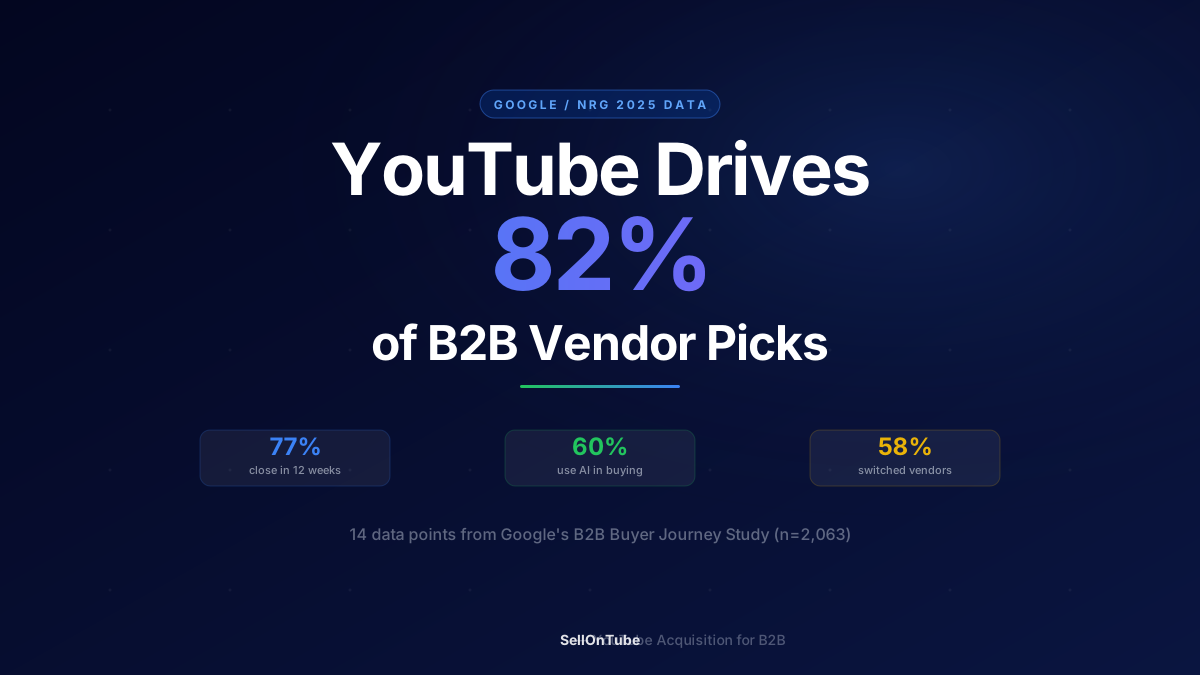
Third, B2B sales cycles shifted. Buyers complete 70-80% of their research before talking to a sales rep. Video fills that gap better than any other format because it builds familiarity and trust at scale. Your prospect watches 6 of your videos over 3 weeks. By the time they book a call, they already feel like they know you. Google’s 2025 study of 2,063 B2B buyers backs this up: 82% purchased from vendors already on their shortlist, and 60% used YouTube during evaluation.
Here is the thing: these shifts did not make video harder. They made it more valuable. But only if you distribute across the channels where B2B buyers actually spend time.
What most channels do: Publish all videos on YouTube and wait for the algorithm. What actually works: Produce once, distribute across four channels, measure pipeline at each touchpoint.
The 4-Channel B2B Video Stack
A B2B video marketing strategy is not a YouTube strategy. It is a distribution system that puts the right video in front of the right buyer at the right stage. Each channel in the stack serves a distinct purpose.
A B2B video marketing strategy is a system that distributes video across four channels: YouTube for search discovery, LinkedIn for professional reach, your website for conversion, and sales team outreach for pipeline acceleration. You start with YouTube search-optimized videos targeting buyer questions, then repurpose that content across the other three channels.
| Channel | Purpose | Content Type | Frequency | Lead Mechanism |
|---|---|---|---|---|
| YouTube | Search discovery | How-to explainers, keyword-targeted deep dives | 2-4 per month | Description link, pinned comment CTA |
| Professional reach | 60-90s clips, opinion takes, founder stories | 3-5 per week | Comment CTA, profile link | |
| Website | Conversion | Product demos, testimonials, explainers | Update quarterly | Embedded CTA, form below video |
| Sales Outreach | Pipeline acceleration | Personalized Loom-style, case study snippets | Per prospect | Direct reply, meeting link |
YouTube: Your compounding search engine
YouTube is the second-largest search engine and the only video channel where content compounds over time. A video you publish today can generate leads 18 months from now without any additional spend.
Focus on buyer-intent keywords. “How to evaluate [your category],” “best [solution type] for [industry],” “[competitor] vs [competitor] comparison.” These searches signal active research. Someone typing “best CRM for agencies” into YouTube is further down the funnel than someone scrolling past your LinkedIn post.
The mistake most B2B companies make: publishing brand-awareness videos on YouTube instead of search-optimized content. Brand videos get 200 views and die. Keyword-targeted videos get found by the right people for years.
Read more: YouTube Marketing for B2B: Generate Leads
LinkedIn: Where B2B decisions start
LinkedIn video reaches decision-makers during their professional browsing time. The format works differently than YouTube. Short, opinionated, personality-driven clips outperform polished productions.
Take a 60-second segment from your latest YouTube video where you make a strong claim or share a surprising insight. Post it natively on LinkedIn with a text caption that adds context. This approach gives you 3-5 LinkedIn posts per week from a single YouTube video, with almost zero extra production cost.
Website: Your conversion layer
Every high-traffic page on your site should answer one question: “Why should I trust you enough to book a call?” Video answers that faster than text.
Embed product walkthroughs on feature pages. Place customer testimonial videos on your pricing page. Add a 2-minute “how we work” video to your homepage. These videos do not need to rank in search. They need to convert the traffic you already have.
Sales outreach: The pipeline accelerator
Your sales team sends emails every day. Nearly all get ignored. A personalized 60-second video referencing the prospect’s specific challenge gets opened, watched, and replied to at rates that make cold email look broken.
But there is a catch. Personalized sales video only works when your reps have a library of reusable assets to pull from. Record 10 common-question videos your sales team can drop into sequences. “Here is how we typically help [industry] companies solve [problem].” These semi-personalized clips scale your team’s output without scaling their recording time.
Video Types That Move B2B Buyers Through the Funnel
Not every video works at every stage. The B2B buyer funnel has three phases, and each phase demands a specific video type.
Awareness: Attract people who do not know you yet
These videos answer the questions your buyers type into YouTube and Google before they know a solution exists. “How to reduce customer churn in SaaS,” “Best ways to qualify enterprise leads,” “Why most content marketing fails for B2B.”
Four video types work at this stage:
- How-to explainers (8-15 minutes): Teach a process your buyer needs. Target a specific keyword. Include a CTA to a relevant resource or tool.
- Industry trend breakdowns (5-10 minutes): Analyze a shift your buyer cares about. Position your perspective as the informed take.
- Myth-busting videos (5-8 minutes): Challenge a common assumption in your space. “Why [popular tactic] is costing you pipeline.”
- Data breakdowns (5-10 minutes): Share original research, benchmarks, or client-anonymized results. Data earns trust faster than opinions.
Consideration: Help buyers evaluate their options
Now your viewer knows the problem exists and is comparing solutions. These videos help them evaluate options without pressuring a sales conversation.
- Comparison videos (8-12 minutes): “[Category] vs [Category]” or “[Your approach] vs [Common approach].” Honest, balanced, with a clear recommendation at the end.
- Process walkthrough videos (10-15 minutes): Show exactly how you solve the problem. Step by step. No vagueness. Buyers trust companies that show their work.
- Webinar replays (20-40 minutes): Record a live session, edit out the fluff, and post the core 20 minutes as a standalone video. Webinars convert at 2-5% into qualified leads when gated, but the replay on YouTube generates search traffic for months. See how YouTube compares with webinars as a standalone lead channel.
Use the YouTube Video Ideas Generator to find high-intent topics your buyers are already searching for.
Decision: Close the deal with proof
At this stage, the buyer has shortlisted you. They need confidence, not more education. Proof is what closes: six B2B founders share their YouTube revenue numbers precisely because sourced evidence beats claims, and the same logic applies to your buyers.
- Product demo videos (3-5 minutes): Screen recordings with voiceover showing your product solving a real problem. No “let me walk you through the dashboard” tours. Show the outcome.
- Customer story videos (3-7 minutes): Your best clients explaining the before and after in their own words. These outperform written case studies because the viewer can read the client’s body language and enthusiasm.
- Personalized Loom videos (60-90 seconds): Your sales rep recording a quick video for a specific prospect, referencing their company, their challenge, and how you would approach it. We have seen these generate 3x the reply rate of text-only outreach.
- FAQ and objection-handling videos (2-4 minutes): Record answers to the 10 questions your sales team hears most often. Drop these into email sequences when a prospect raises that exact objection.
- ROI calculator walkthroughs (3-5 minutes): Screen-record yourself using your own ROI tool with the prospect’s numbers. Use SellonTube’s ROI Calculator to walk through their numbers live. Send it before the call. They show up pre-sold.
The biggest B2B video mistake
Most B2B companies produce only awareness-stage content. They publish “what is” and “how to” videos and wonder why views do not convert to pipeline. The fix: for every 3 awareness videos, produce 2 consideration videos and 1 decision video. This ratio keeps your funnel fed at every stage.
The 90-Day B2B Video Marketing Plan
Ninety days is enough time to build the foundation of a multi-channel video system. This plan assumes one person can dedicate 8-10 hours per week to video production and distribution. If you have a team, compress the timeline.
| Timeline | Action | Video Type | Channel |
|---|---|---|---|
| Month 1: Foundation | |||
| Week 1 | Research 20 buyer-intent keywords, pick top 8 | Planning only | n/a |
| Week 2 | Record and publish first 2 how-to explainers | How-to explainer | YouTube |
| Week 3 | Clip 4-6 short segments from YouTube videos, post natively | 60-90s opinion clips | |
| Week 4 | Record 2 more YouTube videos, embed best YouTube video on homepage | How-to + homepage explainer | YouTube + Website |
| Month 2: Expansion | |||
| Week 5 | Publish 2 YouTube videos targeting consideration-stage keywords | Comparison + process walkthrough | YouTube |
| Week 6 | Record 1 customer story, post clips on LinkedIn and full version on website | Customer story | LinkedIn + Website |
| Week 7 | Record 5 FAQ/objection videos for sales team | Objection-handling | Sales Outreach |
| Week 8 | Publish 2 YouTube videos, continue LinkedIn clips (3-5/week) | How-to + myth-busting | YouTube + LinkedIn |
| Month 3: Optimization | |||
| Week 9 | Audit Month 1-2 performance: views, CTR, leads per video | Analysis only | All channels |
| Week 10 | Record product demo, embed on pricing/feature pages | Product demo | Website |
| Week 11 | Train sales team on personalized video outreach workflow | Personalized Loom-style | Sales Outreach |
| Week 12 | Double down on top-performing formats, cut underperformers | Based on data | All channels |
By day 90, you will have 12+ YouTube videos, 30+ LinkedIn clips, website video on key conversion pages, and a sales outreach video library. Total new production: roughly 20 unique recordings repurposed across 50+ touchpoints.
Month 1: Build the YouTube engine first
Start with YouTube because it compounds. Every video you publish in month 1 will still generate traffic in month 12. LinkedIn clips and website videos produce faster initial results, but they do not compound the same way.
Your first 4 YouTube videos should target the questions your sales team hears most often. Ask your reps: “What do prospects always ask in the first call?” Those questions are your keywords. Someone is typing them into YouTube right now.
Record talking-head or screen-share videos. Do not worry about cinematic production. SellonTube’s script-drafting tool can help you outline these fast. B2B buyers care about the quality of your thinking, not the quality of your B-roll.
Month 2: Layer in the other three channels
Now you have YouTube content to repurpose. Every 10-minute YouTube video contains 4-6 standalone moments that work as LinkedIn clips. Pull the sharpest 60-90 seconds, add captions, and post natively.
So what does this actually mean for your business? It means your one recording session generates a week of multi-channel content. One YouTube video becomes 3 LinkedIn posts, a homepage embed, and a sales enablement asset. That ratio makes B2B video sustainable even with a small team.
This is also when you record your first customer story. One 15-minute interview with a happy client gives you: a 3-minute edited testimonial for your website, 4-5 quote clips for LinkedIn, and a full-length version for your YouTube channel.
Month 3: Optimize and arm your sales team
By week 9, you have data. Look at which YouTube videos generated the most impressions, which LinkedIn clips drove the most profile visits, and which website pages saw higher conversion rates after adding video.
Double down on the formats that performed. If how-to explainers generated 3x the leads of trend analysis videos, record more how-tos. If 60-second LinkedIn clips outperformed 90-second clips, cut shorter.
Week 11 is critical. Train your sales team to use personalized video in their outreach sequences. Record a library of 10 reusable videos addressing common objections. “Here is how we typically help [industry type] companies.” Your reps can send these without recording anything new, then layer in truly personalized 60-second Loom videos for high-priority prospects.
Measuring Video ROI in B2B (Beyond Views)
Views are the metric everyone tracks and nobody should optimize for. A video with 300 views that generates 5 qualified demos is infinitely more valuable than a brand video with 50,000 views and zero pipeline impact.
Here is how to measure B2B video correctly.
The metrics that matter
Pipeline influenced: How many deals in your CRM had a video touchpoint before the first meeting? Track this by asking on intake forms (“How did you find us?”) and by checking YouTube/website analytics against your CRM timeline.
View-to-lead rate: Divide total leads by total views per video. Benchmark for B2B YouTube: 0.5-2% of viewers take a next step (click a link, visit a landing page, book a call). If you are below 0.5%, your CTA placement or targeting needs work.
Influenced revenue: Tag every closed deal where the buyer watched at least one video before converting. Over 12 months, this number tells you the true dollar value of your video investment.
Watch time distribution: YouTube Studio shows where viewers drop off. If 60% leave before the 2-minute mark, your intro is too slow. If they drop off right before your CTA, move the CTA earlier.
Read more: How to Calculate YouTube Marketing ROI for Your Business
Attribution setup in 30 minutes
You do not need an enterprise analytics platform to track video ROI. Three simple systems capture 80% of the data you need.
- UTM links in every video description and pinned comment. Use a consistent format:
?utm_source=youtube&utm_medium=video&utm_campaign=[video-slug]. This shows you which videos drive website traffic in Google Analytics. - “How did you find us?” field on every form. Not a dropdown. A free-text field. Buyers will type “YouTube” or “saw your video on LinkedIn” and give you channel attribution without complex tracking.
- CRM video touchpoint tag. When a lead mentions video in their intake, tag the deal in your CRM. Run a quarterly report showing revenue from video-influenced deals vs non-video deals. You will see the pattern within two quarters.
The metric that changes the conversation
Track “cost per qualified meeting” across channels. Take your total monthly video production cost, divide by the number of qualified meetings where the buyer watched at least one video. Compare that number to your Google Ads cost per qualified meeting. In our experience, video cost-per-meeting drops below paid ads by month 6 to 8 and continues falling from there.
Now, you might be thinking: “This is a lot of effort for 90 days.”
It is. But every week you wait to build your video library, a competitor with less expertise is publishing videos that rank for the keywords your buyers search. They are building trust with your prospects before your sales team even gets the chance. Video compounds. Delay does not.
FAQ
What is a B2B video marketing strategy?
A B2B video marketing strategy distributes video across four channels: YouTube for search discovery, LinkedIn for professional reach, your website for conversion, and sales team outreach for pipeline acceleration. Start with YouTube search-optimized videos targeting buyer questions, then repurpose across the other three channels.
How many videos does a B2B company need to see results?
In our experience, B2B companies start generating measurable pipeline from YouTube after publishing 20 to 30 search-optimized videos over 4 to 6 months. The break-even point arrives faster when videos target buyer-intent keywords with clear CTAs. Website and LinkedIn video can produce leads sooner because distribution is less dependent on search indexing.
What types of video work best for B2B marketing?
The highest-converting B2B video types are product walkthroughs for bottom-funnel buyers, how-to explainers for top-funnel search traffic, and customer story videos for mid-funnel consideration. Match the video type to the buyer stage: educational videos attract, comparison videos convince, and case study videos close.
What does a 90-day B2B video plan produce?
A 90-day plan assuming 8-10 hours per week leaves you with 12+ YouTube videos, 30+ LinkedIn clips, website video on key conversion pages, and a sales outreach video library. Total new production is roughly 20 unique recordings repurposed across 50+ touchpoints. Month 1 builds the YouTube engine, month 2 layers in LinkedIn, website, and sales video, and month 3 audits performance and arms the sales team.
How do you measure B2B video ROI beyond views?
Measure pipeline influenced, view-to-lead rate, influenced revenue, and watch time distribution rather than raw views. A benchmark for B2B YouTube is a 0.5-2% view-to-lead rate. The metric that changes the conversation is cost per qualified meeting: divide your monthly video production cost by qualified meetings where the buyer watched at least one video, then compare it to your Google Ads cost per qualified meeting. In our experience, video cost-per-meeting drops below paid ads by month 6 to 8.
What to Do This Week
- Ask your sales team for the 5 questions they hear most in first calls. Write them down. These become your first 5 YouTube video topics.
- Run those 5 questions through the YouTube autocomplete keyword tool to validate search demand and find related keyword angles.
- Record one 8-minute talking-head video answering the top question. Publish it on YouTube with a keyword-optimized title, description, and a link to your booking page in the first line.
- Pull the strongest 60-second clip from that video, add captions, and post it natively on LinkedIn.
- Add a “How did you find us?” free-text field to your main lead form. You need this for attribution from day one.
- If you want help building the full 90-day plan for your industry, book a 30-minute strategy call and we will map it out together.

Generate video ideas for your business
Stop guessing which topics to cover. The Video Ideas Generator turns your product, customer, and problem into buyer-intent video ideas. Free to try.
Could YouTube work for your business?
We build done-for-you YouTube channels that turn search intent into qualified leads. Check if the math works for you.