· Updated ·  Sathyanand S · YouTube Strategy · 26 min read
6 YouTube Marketing Case Studies With Real Revenue (2026)
6 YouTube marketing case studies with founder-sourced revenue numbers. See how B2B companies use small channels to win customers instead of chasing views.
Six B2B companies get customers from YouTube by doing the same three things, and none of them went viral to get there. Strategy guides keep recommending YouTube for B2B. Arvow, Tiiny Host, Bulk Mockup, Scalelist, LocalRank and Chatwith actually did it, and their founders gave the numbers in interviews we link inline.
The channels most B2B advice points you to, such as SaaStr and Dan Martell, are educators building audiences. These six companies treat YouTube as an acquisition channel instead. Three of the six ran channels under 10,000 subscribers in July 2026.
Treat YouTube as a “views” channel and you build an audience that never buys. Treat it as a search engine for buyers and a 370-view video can pay your rent.
These six YouTube marketing case studies show one three-part play. First, the companies make buyer-intent video that answers a literal search query a prospect types, “how do I upload a CV,” “how to split a design in Photoshop,” “how to share a PDF as a link,” not broad topic content built for reach. Second, they accept low view counts in exchange for high-intent signups: Bulk Mockup turned a 370-view tutorial into three paying customers, and Scalelist credits its small channel with half of all paid users. Third, they optimize each video to rank on two search engines at once, YouTube and Google, and increasingly inside AI answers, so one asset compounds instead of expiring. This is B2B YouTube treated as a YouTube acquisition channel, not a content platform. The metric that matters is customer acquisition, not subscribers or views.
Why trust this analysis: SellOnTube builds the free YouTube channel audit tool and studies B2B YouTube channels used for customer acquisition, and we scored all six companies with that tool in July 2026. Each revenue, lead and customer figure comes from a public founder source, linked inline, with the year the source describes. Nothing is estimated. Where a founder’s own figure and a secondary article disagree, we use the founder’s words and note the gap. We screened 17 companies that are often cited as B2B YouTube successes. Only six had a linkable founder source that credits organic YouTube for customer acquisition, so we published six rather than pad the list.
Key Takeaways
- The winning pattern is buyer-intent video, not viral video. Tiiny Host targets “how do I upload a CV,” not “web hosting.”
- Low views convert. Bulk Mockup’s founder reports a 370-view video that produced three paying customers.
- Subscriber count is a vanity metric in B2B. Scalelist’s founder credited YouTube with 50% of paid users in a 2025 interview, and the channel had 2,660 subscribers in July 2026.
- One video, two search engines. Bulk Mockup says 22% of its YouTube views come from Google; Arvow’s top tutorial pulls 65% from YouTube search plus 20% from Google.
- A pre-built audience compresses launch. LocalRank’s founder says it opened at “nearly $20k MRR right out of the gate.”
- Intent beats reach. In B2B, 300 views from buyers is worth more than 30,000 views from spectators.
Contents
- Does YouTube Actually Work for B2B SaaS?
- The Six Case Studies at a Glance
- Arvow: Founder-Led YouTube at Scale
- Tiiny Host: Ranking for the Literal Question
- Bulk Mockup: A Flywheel Built on Customer Pain
- Scalelist: A Tiny Channel Carrying Half the Funnel
- LocalRank: Building the Audience Before the Launch
- Chatwith: A Vertical Nobody Else Covers
- What Do All Six Channels Have in Common?
- FAQ
Does YouTube Actually Work for B2B SaaS?
A YouTube acquisition channel is a YouTube channel run to win paying customers from search, judged by signups and revenue rather than views or subscribers.
Yes. YouTube works for B2B SaaS when it is run as a YouTube acquisition channel rather than a reach channel. The six companies here show it with founder-sourced numbers, not theory. Scalelist’s founder credited YouTube with 50% of the company’s paid users in a 2025 interview, and the channel had about 2,660 subscribers in July 2026. Arvow’s founder said in a 2025 Starter Story interview that the company reached around $70K in MRR and that most of its users come from YouTube. Bulk Mockup’s founder turned a single 370-view tutorial into three paying customers. None of them went viral, and none of them chased subscribers. What connects all six is a buyer-intent video strategy. Each company publishes videos that answer the literal question a prospect searches when they have a problem the product solves. Then it optimizes each video to rank on both YouTube and Google. Reach is optional; intent is the point.
The Six Case Studies at a Glance
Six companies, six verticals, one playbook. The at-a-glance table gives the fast scan, and the teardowns after it show the work.
The audit column is each channel’s score out of 100 from our own free channel audit tool, run on its last 10 uploads in July 2026. A strong acquisition record and a high audit score are not the same thing. Arvow’s founder-led channels drove a business at around $70K in MRR, yet they score lower today, because the audit grades current on-page execution, not past results.
| Company | Product | ICP | Channel | Subs (Jul 2026) | Sourced acquisition claim | Audit | The one thing |
|---|---|---|---|---|---|---|---|
| Arvow | AI SEO article writer | Founders and marketers doing SEO | @VascoSEOtips | 28,100 | ”around 70,000 in MRR,” ~600 paying clients, “most of our users come from YouTube” (founder, Starter Story interview, 2025) | 60 | Founder-led personal SEO channels, daily for almost a year |
| Tiiny Host | Web and PDF hosting SaaS | Anyone sharing a file or site fast | @tiinytips | 4,330 | Passed $15,000 MRR, close to 1,000 paying subs (founder, Starter Story, 2024) | 81 | Faceless how-to tutorials on literal search tasks |
| Bulk Mockup | Photoshop batch-mockup plugin | Print-on-demand sellers, designers, agencies | @BulkMockup | 9,350 | ”$12K/month,” “customers find us through YouTube” (founder, Starter Story, 2026) | 73 | Content flywheel fueled by logged customer pain |
| Scalelist | AI sales-lead Chrome extension | SDRs and B2B lead-gen teams | @scalelist | 2,660 | YouTube “brings 50% of our paid users” (founder, Pulse Hero, 2025) | 90 | A four-figure-sub channel credited with half of paid users |
| LocalRank | AI local-SEO software | Local-SEO agencies and local businesses | @indexsy | 24,300 | Launched in 2025 at “nearly $20k MRR right out of the gate” off a YouTube audience (founder, IndieHackers interview) | 74 | Daily build-in-public, pre-built launch audience |
| Chatwith | WhatsApp CRM and click-to-chat widget | Micro and SMB service businesses | @LinktoWhatsApp | 16,800 | ”a great channel in YouTube… 500,000 views/month” (CEO, Pulse Hero, 2025; medium confidence) | 55 | Weekly WhatsApp use-case tutorials for non-US SMBs |
Audit scores (0 to 100) come from SellOnTube’s own free YouTube channel audit tool, run on each channel’s last 10 uploads as of July 2026. They grade current execution, which can differ from the era that drove the growth cited here, so read them as a present-day snapshot, not a historical grade. The Chatwith row is medium confidence: the CEO names YouTube in the growth story but does not isolate a YouTube signup percentage, so we never state one.
Arvow: Founder-Led YouTube at Scale
How did an AI SEO tool reach about $70K in monthly revenue with YouTube as its main channel?
Snapshot. Arvow is an AI SEO article writer. In an October 2025 Starter Story interview, founder Vasco Monteiro puts it at around $70K in monthly recurring revenue across around 600 paying clients, on plans from $99 to $700 per month. Asked for the main growth channel, he answers: “Most of our users come from YouTube.” Starter Story host Pat Walls, introducing Vasco, calls it a business “doing basically a million dollars a year.” The Starter Story writeup of the same interview gives the figure as $79K per month.
The channel strategy. Arvow owns a brand channel, but the growth engine was the founder’s personal SEO channels, not the company account. Vasco built money-making assets in three buckets: evergreen tutorials (“best AI SEO writer”), news-jacking videos on Google algorithm updates for subscriber spikes, and viral-for-software explainers. He then multiplied himself, spinning up several channels and hiring camera-comfortable creators paid per performance, and expanding into Portuguese and Spanish. Paid came last. His third step was putting YouTube in-feed ads behind winning videos that had stalled organically.
The one thing others do not. He treated volume as a personal discipline. “I did 20 to 30 minute videos every single day for almost a year.” That cadence, run across founder-led personal channels rather than a polished brand account, is what most B2B teams will not sustain.
Evidence it works. His proof video, a tutorial on how to make a Wikipedia page that was about two years old when he recorded the October 2025 interview, has 1.2M impressions and pulls about 300 views a day, with 65% of views from YouTube search and another 20% from Google search, and it now surfaces inside AI answers. He also moved his call to action to the start and middle of videos rather than the end, which lifted signups.

Audit score: 60 of 100 (as of July 2026): Titles 20, Descriptions 10, Consistency 18, SEO 12. The current personal channel scores mid-pack, strong on buyer-intent titles but thin on descriptions and on-page SEO. A useful reminder that the score grades today’s uploads, not the growth-era run that took the business to around $70K in MRR.
Steal this. Put the founder on camera and publish a daily buyer-intent tutorial for a defined sprint, not the brand account. Build a small library of evergreen how-to videos before you touch anything trend-based. Move your call to action to the first third of the video. Give each video its own UTM link and coupon code, and ask “which creator sent you?” at signup, the tracking stack Vasco describes in the same interview.
Tiiny Host: Ranking for the Literal Question
How does a faceless hosting SaaS win customers straight from YouTube search?
Snapshot. Tiiny Host is a web and PDF hosting SaaS built by solo founder Elston Baretto, a former bank engineer. In a January 2024 Starter Story interview he reported passing $15,000 in monthly recurring revenue, with around 100,000 monthly visitors and close to his 1,000th paying subscriber. An April 2026 Profitable Founder profile frames it as a $1M-a-year business, which we attribute to that profile rather than treat as an established figure.
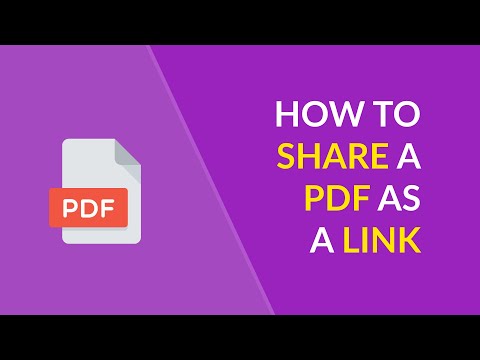
The channel strategy. Faceless tutorials, no personal brand, each one aimed at a low-competition buyer-intent query. The titles are the strategy: “How to Share a PDF as a Link,” “How to Upload Content to Your Own Web Address,” “The Easiest Way to Embed PDFs on a Website.” Every one is a literal job someone is trying to get done right now.
The one thing others do not. Baretto refuses to target the product category. The Profitable Founder profile (2026) sums up his approach: nobody searches “web hosting,” they search “how do I upload a CV.” He captures the task, and the product is the answer.
Evidence it works. On Indie Bites in March 2023, he said his “How to Share a PDF as a Link” video was the top video result in Google for that search, even where Tiiny Host’s own page ranked lower. In the 2024 Starter Story interview he added that some tutorials published over a year earlier were only then reaching 30k+ views. He also said Tiiny Host ranks #1 in Google for “PDF Upload,” which accounts for roughly 40% of revenue.
Audit score: 81 of 100 (as of July 2026): Titles 21, Descriptions 18, Consistency 20, SEO 22. The highest SEO score in the set, which is exactly what you would expect from a channel engineered to rank tutorials inside Google.
Steal this. List the ten literal tasks your product completes and write one video title per task, phrased exactly as a customer would type it. Skip your category keyword entirely. Let the search demand you already know exists find the answer you publish.
Bulk Mockup: A Flywheel Built on Customer Pain
Can a Photoshop plugin get paying customers from low-view YouTube tutorials?
Snapshot. Bulk Mockup is a Photoshop plugin that batch-replaces smart objects to mass-produce mockups, built by founder Vikash Kumar Prajapati and reported at $12K per month on the Starter Story episode “How I Grew My Plugin to $12K/Month” (February 2026). Its ICP is print-on-demand sellers, designers, and agencies.
The channel strategy. Prajapati runs a content flywheel fueled by logged customer pain. He collects real problems from four places: communities he reads silently and never sells in, onboarding emails offering custom tutorials, support tickets he answers with a recorded Loom (over 1,500 of them across three years), and YouTube comments, where a high-comment, low-view video signals unresolved pain. Then he turns those conversations into videos and distributes them with an on-page SEO angle.
The one thing others do not. He does not guess topics. Every video answers a problem a real customer already raised, so the content is pre-validated demand rather than a content calendar.
Evidence it works. In the Starter Story interview he says it directly: “Customer find us through YouTube… he trusts me and then he purchases the product.” His “split the design” tutorial drew 370 views in four months and produced three customers at $15 a month, about $45 in new MRR from a video almost nobody watched. A second video pulled 12,000 views in six months. And 22% of the channel’s views come from Google search, so the same asset ranks in two places.

Audit score: 73 of 100 (as of July 2026): Titles 20, Descriptions 18, Consistency 16, SEO 19. Solid across the board, with publishing consistency the softest dimension, a small gap for a channel this effective.
Steal this. Mine your support tickets and community threads for the exact phrasing customers use, then record a video answering each one. Optimize the title, description, and first 30 seconds of the transcript for that phrase so the video ranks on Google too. To see how a competitor words the same answer, pull their transcript with one of the YouTube transcript generators we compared for business research. Judge each video on customers, not views.
Three case studies in, the pattern should look familiar. If you want to know how your own channel measures up on the same four dimensions before reading the next three, run it through the free channel audit, it takes under a minute.
Those four dimensions are the public half of an audit. The other half, reading YouTube Studio and tracing leads back to videos, is laid out step by step in our audit checklist for business channels.
Scalelist: A Tiny Channel Carrying Half the Funnel
How does a channel this small drive half of a SaaS’s paid users?
Snapshot. Scalelist is an AI sales-lead database, a Chrome extension that extracts and enriches LinkedIn Sales Navigator leads, built for SDRs and B2B lead-gen teams by founder Youssef El Kaddioui.
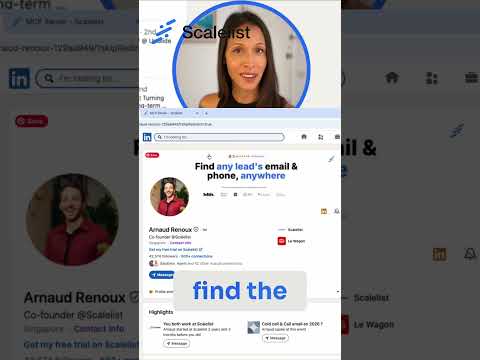
The channel strategy. Screenshare lead-generation tutorials with a heavy AI angle. El Kaddioui started posting them in November 2023, and the channel had 2,660 subscribers in July 2026. That is small by creator standards, which is the point.
The one thing others do not. Scalelist proves subscriber count is a vanity metric in B2B. A channel most creators would call a failure carries half the company’s paid-user acquisition, because the few people watching are exactly the people who buy.
Evidence it works. In his March 2025 Pulse Hero interview, El Kaddioui says: “YouTube started picking up after a few months… It now brings 50% of our paid users.” His channel breakdown puts YouTube at about 50%, SEO at about 15%, and the rest across the Chrome Web Store, referrals, and LinkedIn. Half the paid funnel from a four-figure-subscriber channel.
Audit score: 90 of 100 (as of July 2026): Titles 22, Descriptions 24, Consistency 25, SEO 19. The top score in the set, on the smallest channel in the set. The execution is tight even though the audience is tiny, which is the whole point.
Steal this. Stop tracking subscribers and start tracking which videos precede signups. Record the workflow your buyer performs, screenshare and all, and rank for how they search it. Accept that a small channel is fine if the right buyers are on it.
LocalRank: Building the Audience Before the Launch
What happens when you build the YouTube audience before you launch the product?
Snapshot. LocalRank is AI local-SEO software for Google Business Profile rank tracking, built by Jacky Chou of Indexsy, serving local-SEO agencies and local businesses. His channel runs a daily build-in-public feed.
The channel strategy. Chou posted a YouTube video every day, assembling an audience of the exact operators who would later need the product. By the time LocalRank shipped, the demand already existed. Worth disclosing: this is a personal and portfolio channel that also promotes his courses, but the link from the SaaS to YouTube is explicit in his own words.
The one thing others do not. He built the distribution before he built the launch. Founders usually launch to silence and then scramble for an audience. Chou reversed the order.
Evidence it works. In an IndieHackers interview he states that “videos with relatively low view counts drive significantly more product signups than posts that get tens of thousands of impressions on other platforms,” and that LocalRank launched at “nearly $20k MRR right out of the gate” off the pre-built audience. His own post from March 2025 caught the launch in real time: “Posted a YouTube video every day… launched Localrank.so 2 days ago… already at $2k MRR.”
Audit score: 74 of 100 (as of July 2026): Titles 18, Descriptions 15, Consistency 22, SEO 19. The daily cadence lifts consistency, while titles and descriptions carry the most headroom to improve.
Steal this. If you are pre-launch, start publishing buyer-intent videos now, before the product is ready, so you launch to demand instead of silence. Pick a daily or near-daily cadence you can actually hold. Track signups per video, not impressions.
Chatwith: A Vertical Nobody Else Covers
Can a WhatsApp tool grow on YouTube in a market most B2B advice ignores?
Snapshot. Chatwith, also seen as Tochat.be, is a WhatsApp CRM and click-to-chat widget with forms and a multi-agent inbox, built for micro and small service businesses on WhatsApp: real estate, auto, education, beauty, mostly outside the US. It is led by CEO Cesar Martin.
The channel strategy. Weekly WhatsApp use-case tutorials aimed at a non-US SMB audience, a vertical none of the other five companies touch. The content meets a specific buyer where they already are, on WhatsApp workflows, in their language.
The one thing others do not. It serves an underserved, non-US, small-business audience that most B2B YouTube advice ignores entirely.
Evidence it works. This one is medium confidence, and we flag it as such. In his February 2025 Pulse Hero interview, Martin says: “we found a great channel in YouTube, where we have more than 500,000 views per month,” alongside about 5,000 new users a month and 17,000 premium users. He names YouTube as a great channel in the growth story, but does not isolate a YouTube signup percentage, and the signups are co-mingled with AppSumo and SEO. So we credit the reach and the vertical insight, and we do not claim a YouTube-specific conversion number.

Audit score: 55 of 100 (as of July 2026): Titles 14, Descriptions 8, Consistency 23, SEO 10. The lowest score here. Uploads are consistent, but weak titles, thin descriptions, and light SEO leave signups on the table. The reach is real, the on-page execution is not there yet, which fits why this is the one medium-confidence case in the set.
Steal this. Find the vertical your competitors consider too small and make tutorials for the exact tool your buyer already lives in. Publish weekly and consistently. Do not over-claim your own attribution, and set up tracking so you can prove the channel’s contribution later.
What Do All Six Channels Have in Common?
All six channels treat YouTube as a search engine for buyers, not a stage for an audience. Each one answers a literal buyer search, accepts low views in exchange for high intent, and ranks the same video on YouTube and Google.
A buyer-intent video is a video that targets the literal search query a prospective customer types when they have a problem your product solves, chosen for purchase intent rather than for reach. That definition is the whole strategy in one sentence, and all six companies live inside it.
The founder evidence lines up:
- Tiiny Host ranks tutorials for the literal task. Separately, its founder ties roughly 40% of revenue to Google page SEO: ranking #1 for “PDF Upload” (2024).
- Bulk Mockup turned 370 views into three customers, and 22% of its views arrive from Google (2026).
- Scalelist credits YouTube with half its paid users (2025), on a channel with 2,660 subscribers in July 2026.
- Arvow’s founder says most of its users come from YouTube, and his proof video draws 65% of views from YouTube search and 20% from Google (2025).
- LocalRank launched in March 2025 at nearly $20k MRR off a pre-built audience.
- Chatwith reaches 500,000 monthly views inside an SMB vertical most B2B YouTube advice ignores (2025).
Our own audit scores add one observation about these six. The scores average 72 of 100 (433 points across six channels). The top score, 90, belongs to the smallest channel, Scalelist, at 2,660 subscribers. The two lowest scores, 60 and 55, belong to the largest channel (Arvow, 28,100 subscribers) and the third largest (Chatwith, 16,800). In this set, audit score did not rise with channel size. Six channels is a small sample, so read it as an observation about these six, not a rule.
Two of these founders independently confirm the compounding mechanism. Vasco at Arvow and Vikash at Bulk Mockup both describe low-view, high-intent buyer-intent videos on job-to-be-done queries ranking on Google as well as YouTube, and increasingly being surfaced by AI answer engines. When two operators in unrelated categories report the same effect without prompting, it is a pattern, not a fluke.
The playbook is six moves, and each one has a company that proves it with a sourced number. This table is the whole strategy on one screen.
| The move | The company that proves it | The number |
|---|---|---|
| Title the buyer-intent query | Tiiny Host | ”How to Share a PDF as a Link” was the top video result in Google (founder, 2023); ranking #1 for “PDF Upload” brings ~40% of revenue (founder, 2024) |
| Accept low views for high intent | Bulk Mockup | 370 views → 3 customers → ~$45 new MRR |
| Rank on two search engines | Arvow | One tutorial: 65% of views from YouTube search plus 20% from Google, 1.2M impressions |
| Track self-reported attribution | Scalelist | YouTube credited with 50% of paid users (founder, 2025) |
| Build the audience before launch | LocalRank | Launched in 2025 at “nearly $20k MRR right out of the gate” (founder, 2026) |
| Make content from support pain | Bulk Mockup | 1,500+ recorded support tutorials over 3 years feed the videos |
The worldview underneath all of this: a 370-view video that produces paying customers beats a 100,000-view video that produces subscribers. Chase views and you build the wrong asset, an audience that will never buy. Chase intent and a channel most people would call too small becomes a working acquisition channel. If you want to see where your own channel sits on this pattern, score your channel against the same signals these six share.
Lead capture through YouTube ads or paid placements is a different job. If ads are your question, read whether YouTube Ads work for B2B lead gen. If you came looking for big consumer-brand campaigns, Google’s Think with Google library publishes those. These six case studies cover B2B companies that use organic YouTube for customer acquisition.
FAQ
Will YouTube actually work for my B2B company?
Yes, when you run it for customer acquisition instead of reach. Scalelist’s founder said in 2025 that YouTube brings 50% of the company’s paid users. Arvow’s founder said the same year that most of Arvow’s users come from YouTube. Neither is a big creator channel. All six case studies follow one pattern: buyer-intent videos that answer a literal search question convert far better than high-view content built to grow an audience.
How many views do you need to make $10,000 a month on YouTube?
For a B2B company, that is the wrong question. It assumes you earn from ad revenue, where views equal money. B2B YouTube earns from customer acquisition, where a single buyer can be worth thousands. Bulk Mockup’s founder reported a 370-view video that produced three paying customers. A handful of the right viewers beats tens of thousands of the wrong ones, so measure signups and pipeline, not views. Our YouTube ROI guide for SaaS walks through the math.
How long until YouTube brings my B2B company customers?
Plan for months, not days. Scalelist’s founder started posting screenshare videos in November 2023 and says YouTube started picking up after a few months, before it became the company’s largest acquisition channel. LocalRank’s founder posted daily to build an audience, then launched with revenue already flowing. Each video keeps ranking, so the return arrives once a body of buyer-intent videos exists, not after your first upload. Put those months, the budget and your break-even client count into a YouTube channel business plan before you start.
Do I need a lot of views to get customers from YouTube?
No. Low view counts convert well when the views are high intent. Bulk Mockup’s founder describes a video with 370 views over four months that produced three paying customers, and LocalRank’s founder says low-view videos drive more product signups than posts with tens of thousands of impressions elsewhere. In B2B, 300 views from buyers beats 30,000 views from spectators.
Can one YouTube video rank on Google as well?
Yes, and that is a large part of why this works. Bulk Mockup’s founder says 22% of the channel’s views come from Google search. Arvow’s founder describes a single tutorial that pulls 65% of its views from YouTube search and another 20% from Google, and is now surfaced inside AI answers too. One optimized video can rank on two search engines at once, so the asset compounds instead of expiring.
What kind of YouTube videos should my B2B company make?
Make buyer-intent videos that answer the literal question a prospect types when they have a problem your product solves. A 2026 Profitable Founder profile of Tiiny Host puts it plainly: nobody searches “web hosting,” they search “how do I upload a CV.” Target the low-competition how-to query, solve it completely on camera, and let the person who needed that answer find your product. That is what separates a B2B YouTube strategy from a creator one.
Are there YouTube case studies for big brands or YouTube ads?
Yes, but they answer a different question. Google’s Think with Google library publishes brand campaign case studies. The six case studies here are B2B companies that use organic YouTube for customer acquisition, with founder-sourced numbers. If paid YouTube is your question, our YouTube Ads for B2B breakdown covers cost, targeting and when ads make sense. Arvow is the one overlap: its founder put in-feed ads behind organic videos that had stalled.
Why don’t companies like Ahrefs or Apollo appear in these case studies?
In July 2026 we screened 17 companies, including Ahrefs, Apollo.io, Wistia and tl;dv. Only six had a linkable founder source that credits organic YouTube for customer acquisition. For the rest, the public founder sources we found credited other channels, or we found no linkable founder quote at all. That says nothing about how those companies actually grow. It means we could not source the claim, so we left them out rather than pad the list.
Audit your channel against these six
These six companies all score high on the same buyer-intent signals. Run your own channel through the free YouTube channel audit tool to see how your last videos rate on customer-acquisition fit, not views, and where the gap is.
What to Do This Week
- List the ten literal tasks your product completes, phrased exactly as a customer would search them (“how do I…”), then find the exact phrases buyers type into YouTube.
- Pull the top questions from your support tickets and community threads; those are pre-validated video topics.
- Pick the three lowest-competition buyer-intent queries and script one video for each, starting from these B2B YouTube script templates.
- Put your title keyword in the title, description, and first 30 seconds of the script so the video can rank on Google too.
- Move your call to action to the first third of the video, not the end.
- Set up per-video tracking (a coupon code or a “how did you hear about us” field) so you can attribute signups. Start with self-reported attribution and per-video codes.
- Run your channel through the channel audit and fix the lowest-scoring dimension first.

Could YouTube work for your business?
We build done-for-you YouTube channels that turn search intent into qualified leads. Check if the math works for you.